
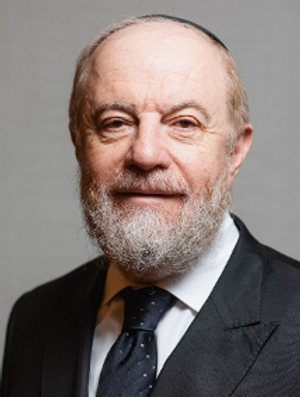
ALEXANDER POLTORAK
THEORETICAL PHYSICIST, NEUROSCIENTIST, AUTHOR
Alexander Poltorak is a theoretical physicist, neuroscientist, author, and public intellectual. Trained in theoretical physics in the Soviet Union, he later became a political dissident and immigrated to the United States with his family.
He went on to hold faculty appointments in biomathematics, neuroscience, and physics at Cornell University Medical College, Touro College, and The City College of New York.
He is the author of A Light Unto My Path and co-author of several books published by Wiley. He is a widely published essayist, with op-eds on public affairs in The Hill, The American Spectator, and The Washington Times. Through his writing at QuantumTorah.com, he explores the deep resonances between Jewish theology, science, and philosophy.
Is it Rational to Believe in God?
Alexander Poltorak
As a physicist, I found God in science. I cannot prove God’s existence because God does not exist in the ordinary sense; He transcends our notion of existence.(1) To demand material proof for God is a category error. Only souls couple with godliness.(2) Souls can sense God, but this is a first-person experience that cannot be articulated.(3) I call it “private knowledge.”(4) We can also infer God from science and logic. What I offer, then, is cumulative plausibility, rather than proof.
Classical philosophy offers ontological,(5,6,7) cosmological,(8) teleological,(9) and related compelling arguments for God.(10) Although none is dispositive alone, together they create a convincing case for God. I propose an apophatic reformulation grounded in God’s limitlessness rather than maximal greatness.(11) While logic cannot encompass God,(12) it shows that it is rational to believe. That said, we should look for pointers, rather than certainties.
Philosophers ask: Why is there something rather than nothing? A “brute fact of nature” answer is deeply unsatisfying.(13) Nothing can move or cause itself; it must be moved or caused by something else. At the end of the causal chain, we find the Unmoved Mover, a.k.a. the First Cause or the Creator.(14)
Why does anything change?(15) Every chain of causes points to an uncaused First Mover beyond the physical universe.(16) It also points back to the mystery of the Creation.(17)
We inhabit a “Goldilocks Universe,” with physical constants balanced on a razor’s edge.(18) The probability of this setting by chance is de minimis.(19) Another puzzle is the intelligibility of the universe.(20) The go-to counterargument, the multiverse, is a metaphysical escape hatch, positing an infinite number of unobservable universes to explain away the apparent design of this one.(21)
Physics describes the behavior of passive matter.(22) However, the simplest unicellular organism behaves purposefully:(23) it seeks nourishment and avoids danger, preserves and repairs itself, grows and strives to reproduce.(24) Yes, complexity emerges naturally,(25) and dissipative structures self-organize,(26) but purposefulness is another matter entirely.(27) Physics cannot account for telos (meaning “purpose” in Greek) emerging from matter that has none. Life is physics subordinated to purpose.(28)
If the universe is a broadcast of divine intent, the soul is the receiver. We possess an innate sensus divinitatis—a “sense of the divine.” Failure to perceive God may only reflect an out-of-tune receiver overwhelmed by noise. As a radio must be tuned, the human soul can be tuned to the frequency of the divine through moral discipline and spiritual alignment.(29) God’s faint voice becomes audible only when the noise of the self is silenced.
While there is no logical or empirical proof of God, I can claim something humbler and stronger: a compelling case based on collective evidence.(30) The world exists and is fine-tuned; life is purposeful; and the soul is receptive to transcendence—these pointers converge, and the evidence is overwhelming.
Intellectually, I find belief in God far more rational. However, faith transcends intellect. I have experienced divine providence and the ineffable presence of God. Above all, I believe because my soul is entangled(31) with God.
Footnotes:
1) (a) One can say that something exists only so long as it may exist or not. By stating that something exists, we specify one of these two possibilities. Similarly, a person can be alive or, God forbid, not alive. By stating that a person is alive, we specify that he is not dead. Such existence is a contingent existence. In this sense, to say that God exists is meaningless, because nonexistence for God is not an option. Such existence is called “necessary” existence. Indeed, the Maimonides (Rabbi Moshe ben Maimon, a.k.a. Rambam) writes that God’s existence is necessary. Therefore, a statement such as “God exists” contains no information.
(a) From another point of view, existence is a temporal construct. For something to exist is to persist in time. Something may have existed in the past, but no more. Or it may exist in the future, but not now. Or something, such as my present feeling of existence, may exist only now. Existence is necessarily time-bound. God, on the other hand, is above time. Consequently, the word “exists” is meaningless when applied to God.
When speaking of God, philosophers speak of “necessary existence,” meaning to say that this existence is not contingent on any predicate but is its own source. Or, in the language of modal logic, God exists in all possible worlds. To say it in other words, it means God cannot… not exist. That is, however, an impermissible limitation of unlimited God. Borrowing from quantum mechanics, it is better to say that, allegorically speaking, God is in “a state of superposition” of existing and not existing, as it were. To be sure, this is little more than a poetic metaphor.
2) (a) This illustrates the principle of Ontological Resonance or the ancient axiom “Like knows Like” (Similia similibus cognoscuntur). In physics, an interaction requires the probe to share a quantum number or coupling constant with the field it enters. For example, to detect an electromagnetic field, we need an electrically charged particle, such as an electron, that couples with the field. A neutral probe cannot detect a field with which it doesn’t couple. Similarly, a consciousness devoid of the divine—focused only on the material—cannot perceive God. We do not find Him because we have stopped being like Him. Detection requires affinity. Without interaction, detection is impossible; without shared properties, interaction cannot happen. A neutrino passes through enormous amounts of matter with minimal interaction because it has no electric charge (it doesn't “feel” the electromagnetic force). To prove God through the scientific method is like using a metal detector to find plastic; the instrument is not suited for the object. In engineering, a sensor is a transducer—it converts one form of energy into another. A transducer only functions if it is sensitive to that specific input energy. A receiver cannot decode a signal it cannot resonate with. You cannot catch a radio wave with a windsock. The windsock is designed for wind’s kinetic energy, not radio waves. Using material instruments to detect Gd is like using windsocks to catch a radio broadcast. We fail not because the broadcast isn't there, but because we are using the wrong instrument.
(b) In philosophical terms, the mode of the knower must correspond to the mode of the known. (Adaequatio rei et intellectus — the adequation of the mind to reality). Empiricism, bound by the observable, cannot measure the Unobservable.
Science deals with the processes within the natural world (secondary causes), whereas God is posited as the origin of the natural world (the First Cause or Prime Mover). As such, God is outside the purview of natural science.
3) The modern skeptical demand is, “Show me God, and I will believe.” This assumes that the human apparatus, in its current state, is capable of seeing. However, just as a blind man cannot see the sun despite the sun's overwhelming brightness, a spiritually malnourished soul cannot perceive God. The “proof” is not external data, but internal resonance. This aligns with the concept of the Noetic quality of religious experience described by William James—states of insight into depths of truth unplumbed by the discursive intellect.
4) The “private knowledge” is the truths accessed through direct, first-person subjectivity which are, by definition, non-transferable. Unlike “public knowledge”—facts like gravity which can be verified by anyone regardless of their internal state—private knowledge is akin to qualia, like the redness of a rose or the taste of honey. You can describe the physics of light (public knowledge), but you cannot convey the experience of “red” to a blind man. Similarly, the soul’s perception of God is an undeniable, self-authenticating reality for the perceiver that remains inaccessible to the external observer, not because it is unreal, but because it is experiential rather than propositional.
5) Classical formulations of the ontological argument proceed a priori. Anselm argues from the concept of “that than which nothing greater can be conceived”; Descartes argues that existence belongs to the essence of a supremely perfect being as “three angles belong to a triangle.”
(a) Anselm's Ontological Argument, found in his Proslogion (11th century) is purely a priori. The argument begins with the definition of God as “that than which nothing greater can be conceived” (aliquid quo nihil maius cogitari possit). He argues that even the “fool,” who denies God, understands this definition, meaning this Being exists at least in the fool's understanding. However, it is objectively greater to exist in reality than to exist merely in the understanding. Therefore, if “that than which nothing greater can be conceived” existed only in the mind, one could conceive of a being that was identical but also existed in reality, which would be greater. This would create a contradiction (the greater being not the greatest). Thus, by definition, the Greatest Conceivable Being must exist both in the understanding and in reality.
Descartes’s formulation of the Ontological Argument, found in his Fifth Meditation, shifts the focus from Anselm's “greatest conceivable being” to the concept of intrinsic nature (or essence). Descartes argues that existence is a perfection (an attribute of greatness). He defines God as a “supremely perfect being” possessing all perfections. Therefore, just as it is impossible to imagine a triangle without three angles or a mountain without a valley (because those attributes are part of the object’s essence), it is impossible to imagine a perfect God without the attribute of existence. To say “God lacks existence” is a contradiction, effectively saying “the perfect being is imperfect.” Thus, God’s existence is as self-evident and necessary as a geometric truth.
6) Leibniz’s Argument (Modal Formulation): Leibniz’s version begins not from the concept of God but from the contingency of the world and the Principle of Sufficient Reason (PSR).
(PSR): Every distinct state of affairs that obtains (is true) has a reason or explanation for why it is so and not otherwise.
Modal Definition of Contingency: The Universe exists, but it is contingent. In modal terms, this means its non-existence is logically possible. There are possible worlds where the universe does not exist or exists differently.
The Failure of Internal Explanation: Because the universe is the aggregate of all contingent things, it cannot explain its own existence. Citing another contingent thing within the set only pushes the question back (infinite regress is not a sufficient reason).
Requirement for Necessity: To satisfy the PSR, the chain of contingent explanations must terminate in a Necessary Being—an entity that exists in all possible worlds.
Conclusion: A Necessary Being exists as the sufficient reason for the contingent universe. This being’s existence is self-explanatory because it is impossible for it not to exist.
7) Plantinga and Gödel offer modern modal versions that recast the ontological argument in the language of possible worlds.
(a) Plantinga's Modal Ontological Argument:
The Possibility Premise: It is logically possible that a “Maximally Great Being” exists. (i.e., the concept of God is not contradictory like a “square circle”; there is at least one possible world where God exists).
Definition of Maximal Greatness: A being is “Maximally Great” only if it possesses Maximal Excellence in every possible world.
Definition of Maximal Excellence: To have Maximal Excellence entails having omnipotence, omniscience, and moral perfection.
The Modal Logic Step: If it is possible that a necessary being exists (exists in at least one world but its nature is to exist in all worlds), then it follows that this being must exist in all possible worlds, including the actual world.
Conclusion: Therefore, a Maximally Great Being exists in the actual world.
(b) Gödel’s Ontological Argument:
Kurt Gödel, one of the greatest logicians in history, sought to provide a mathematically rigorous proof for the existence of God using modal logic. His argument relies on the concept of “positive properties” (qualities that are purely good, independent of accidental circumstances).
Axiom of Positivity: He asserts that properties can be divided into "positive" and "negative," and that positive properties are consistent (they can coexist).
Definition of God: He defines a "God-like" being as one that possesses all positive properties.
Existence is Positive: He posits that “necessary existence” (existing independently and eternally) is a positive property.
The Modal Step: If it is logically possible for a God-like being to exist (meaning the concept is not contradictory), and if “necessary existence” is one of its properties, then it follows by the rules of modal logic that such a being must exist in all possible worlds.
Conclusion: Since a God-like being possesses the positive property of necessary existence, and it is possible for such a being to exist, God therefore exists necessarily.
8) Cosmological Argument (a.k.a. Kalam argument) focuses on the origin of the past, relying on the syllogism that: (i) Whatever begins to exist has a cause; (ii) The universe began to exist (according to the Big Bang cosmology and the impossibility of an infinite regress of time); (iii) Therefore, the universe has a cause. This points to a Creator who is beginningless, spaceless, immaterial, and timeless—necessary qualities to create time and space from nothing.
9) Teleological Argument (Watchmaker Analogy): The most famous illustration of the Argument from Design is William Paley’s “Watchmaker Analogy.” Paley argued that if one were to stumble upon a watch in a heath, its complexity—gears, springs, and precise movement functioning together for a specific purpose (telling time)—would force the conclusion that it was not formed by random natural forces, but by an intelligent agent. Similarly, the universe exhibits a complexity and functional integration (e.g., the human eye) far surpassing any watch, implying a Grand Designer. This very same argument was made by Maimonides (Rambam) in his Guide for the Perplexed in the 12th century. A similar argument regarding a well-kept mansion found in a wilderness was also made in 12th century by Yehuda Halevi in Kuzari, and by Abraham ibn Daud in “The Exalted Faith”; the order, structure, and provisioning of the palace serve as undeniable proof of a hidden Architect and Sustainer, for chaos does not spontaneously generate sustained order. Even earlier, in his Ennead III.2, Plotinus, the founder of Neoplatonism, argues that the order of nature, like that of a well-governed state, points to a governing “master Reason” behind it.
10) Thomas Aquinas in his Summa Theologiae, presented the Five Ways (Quinque Viae) to demonstrate the existence of God:
(a) The Argument from Motion (The Unmoved Mover):
We observe that things in the world are in motion (changing from potentiality to actuality). Nothing can move itself; it must be moved by something else. Since an infinite chain of movers is impossible (you can’t have a chain of falling dominoes without a first push), there must be a First Mover who is not moved by anything else.
(b) The Argument from Efficient Cause (The First Cause):
In the world of sense, we find an order of causes and effects. Nothing can be the cause of itself (it would have to exist before itself). Going back infinitely in causes is impossible because without a first cause, there would be no intermediate causes or final effects. Therefore, there must be a First Efficient Cause.
(c) The Argument from Contingency (The Necessary Being):
We see things that can either exist or not exist (they are contingent). If everything were contingent, there would have been a time when nothing existed. If nothing existed then, nothing could begin to exist now. Therefore, not all beings can be merely contingent; there must be one Being whose existence is necessary (it must exist) and not dependent on another.
(d) The Argument from Gradation (The Maximum Being):
We observe degrees of quality in things (some things are better, truer, or nobler than others). Comparative terms like “more” or “less” are only meaningful in relation to a maximum standard (the “most”). Therefore, there must be something that is the truest, best, and noblest—the ultimate standard of perfection and the cause of these qualities in others.
(e) The Argument from Design (The Grand Architect):
We see that natural bodies which lack intelligence (like rocks or planetary orbits) act for an end or purpose (teleology). Things without intelligence cannot move towards a specific end unless directed by an intelligent being (just as an arrow is directed by an archer). Therefore, some intelligent being exists by whom all natural things are directed to their end.
11) Apophatic version of Ontological Argument:
I find existing formulations of the Ontological Argument unsatisfying and incompatible with apophatic theology (any positive statement impermissibly limits God, who can only be described negatively, what He is not) and the Jewish conception of God as Ayn Sof (Limitless) and propose a novel formulation. My version replaces the comparative concept of “Maximal Greatness” with the negative definition of “Limitlessness” (aligning with the Kabbalistic Ayn Sof and Neoplatonic apophatic tradition). The logic posits that if a Limitless God exists in at least one possible world, He must necessarily exist in all possible worlds; otherwise, His existence would be restricted by the worlds in which He is absent, creating a contradiction with His definition as Limitless. Thus, by granting the mere logical possibility of a Limitless Being, one is logically compelled to grant Its necessary existence. This approach bypasses critiques regarding subjective “greatness” by rooting the definition in the objective absence of boundaries.
12) (a) God is not limited by logic. Moreover, the Transcendental Argument for God claims that the preconditions for logic, reason, and science presuppose the existence of God. We assume the laws of logic (like A=A) are universal, invariant, and abstract entities. In a purely material, random universe, there is no reason to trust that our brains (evolved for survival, not truth) provide accurate information about reality, or that the laws of logic apply everywhere. God provides the necessary foundation and grounding for the intelligibility of the universe.
(b) Logic does not tolerate contradictions. As Bertrand Russell showed, the use of self-referential constructs often leads to contradictions. If you consider a set of all sets that do not contain themselves, does this set contain itself? If it does, then it doesn’t; and, if it doesn’t, then it does. Or, consider a statement, “This statement is false.” If it is true, then it is false, but if it is false, then it is true… a contradiction. However, God is the ultimate self-referential (in the words of Maimonides, He knows all by knowing Himself; there is nothing other than God—ein od milvado) and self-contradictory (He exists, but He is not limited by His existence) construct. Any formal logic fails to describe God. Infinite God possesses the power of bli gvul (infinitude) and gvul (finitude); hence, the paradox: Can God create a stone that He cannot lift? This is a manifestation of the cardinal principle of Jewish theology, nimno hanimnaot (not limited by any limitations). Any self-referential or self-contradictory constructs about God, (such as, Can God create a stone that He cannot lift?) are only “paradoxes” from our limited human perspective—they do not reveal any limitation or deficiency in God, but merely reflect limitations of human logic unable to grapple with self-referential, infinite God.
(c) Kurt Gödel’s Incompleteness Theorems, roughly speaking, demonstrate that even within rigid logical systems, there are truths that are true but unprovable within that system. Moreover, as Gödel showed, one cannot prove the consistency of a formal theory by means of that theory. Trying to prove God’s existence in the context of any formal theory would violate Gödel’s theorem because there is nothing outside of God.
(d) Modern mathematics defines axioms merely as consistent starting points, not universal truths. However, philosophy still clings to the archaic demand that foundational premises be intuitively obvious to everyone. Drawing on Wittgenstein’s “hinge propositions” and Plantinga’s “Properly Basic Beliefs,” I define Private Knowledge as the set of unprovable commitments (e.g., belief in God or moral realism) that serve as the lens through which all other evidence is interpreted. The same facts are interpreted differently depending on one’s metaphysical convictions. Where the atheist sees proof of God’s absence, the theist, relying on the “Private Knowledge” of God’s goodness, logically infers a hidden purpose. I argue that we must abandon the attempt to force “public” proofs for metaphysical claims. Instead, we should view these disagreements as collisions between distinct, internally consistent systems of rationality that share no common axiomatic ground.
(e) We are epistemologically limited in our ability to know God. That is why God stopped Moses when he came towards the burning bush to “investigate this wondrous phenomenon,” saying: “Do not draw near here.” (Exodus 3:2-5) We are limited in our knowledge of the Creator by what He chooses to reveal to us about Himself, as He did to Moshe from the burning bush.
As British theistic philosopher Richard Swinburne noted, were a logical construct proving the existence of God to be found, that would imply that this construct “precedes” God as it were, and that God “owes” it existence to this principle, which would render God’s existence contingent on this principle rather than necessary, which is self-contradictory—God who requires a reason for His existence is not God.
13) Some philosophers reject the premise that existence requires an explanation at all. Thinkers like Bertrand Russell argued that the universe doesn’t need a reason. As Russell famously stated in a 1948 BBC radio debate, “I should say that the universe is just there, and that's all.” Proponents argue that just because everything within the universe has a cause doesn’t mean the universe as a whole requires a cause. Demanding a cause for existence itself might simply be a misapplication of human logic to a cosmic scale (“the Fallacy of Composition”). I find the appeal to the brute facts of nature deeply unsatisfying as an escape from having to admit the existence of the Creator as the most logical answer.
14) The Principle of Sufficient Reason (The Theistic/Cosmological Argument) proposed by Leibniz states that everything that exists must have an explanation or a reason for its existence. (See endnote Error! Bookmark not defined. above.) The universe and everything in it are “contingent”—meaning they could have easily not existed. Since contingent things cannot explain their own existence, the explanation for the universe must lie outside it. Leibniz argued that to avoid an infinite regress of causes, there must be a “necessary being”—an entity that must exist by its very nature, and upon which all contingent things depend. In classical philosophy and theology, this necessary being is identified as God. Some scientists, Lawrence Krauss and Stephen Hawking, attempted to explain the existence of something by the instability of quantum vacuum. However, this approach presupposes the existence of space, time, and the law of physics (specifically, quantum field theory)—this is not “nothing.”
15) And, if there is something, why does it change? The problem of change is actually one of the oldest questions in philosophy, predating Socrates. In ancient Greece, Parmenides argued precisely what one might intuitively suspect: logically, change shouldn't exist. He argued that reality is a single, unchanging, indivisible whole. His logic was that for something to change, it must go from a state of "non-being" to "being." But since "non-being" (nothingness) cannot exist, it cannot produce anything. Therefore, Parmenides concluded, change is a cognitive illusion. Our senses deceive us; reality is perfectly static. Heraclitus argued the exact opposite. He claimed that stasis is the illusion, and change is the fundamental substance of reality. He famously said, "No man ever steps in the same river twice, for it's not the same river and he's not the same man." To Heraclitus, existence isn't made of "things"; it is made of fire, flux, and constant transition. Aristotle synthesized these two extremes and provided the framework that dominated Western thought for 2,000 years. He realized Parmenides was wrong to say change required moving from "nothing" to “something.” Instead, Aristotle proposed that things possess potentiality and actuality. A block of marble is actually a rock, but it is potentially a statue. Change is simply the process of potentiality becoming actuality. The capacity for change is baked into the very nature of existence. Building on this, Thomas Aquinas’s “Argument from Motion” starts with the empirical observation that change is the fundamental feature of the universe. Classical theology views God not just as a builder who walked away, but as the “Prime Mover” who continuously sustains the dynamic, changing nature of reality. In the 20th century, mathematician and philosopher Alfred North Whitehead developed "Process Philosophy." Similar to Heraclitus, Whitehead argued that Western logic made a mistake by focusing on "substances" (nouns). He argued the universe is actually made of "events" (verbs). A tree isn't a static object that occasionally undergoes change; a tree is a continuous, unfolding process. If reality is a series of events, then change isn't something that happens to reality; change is reality. Yet, the unease with change persists. Albert Einstein, who believed in a steady-state universe, famously resisted the possibility that the universe is expanding. Change is such an unnatural phenomenon that mathematics fails to fully describe it. Granted, calculus, dynamical systems, differential equations give us adequate tools to model change. By they don’t engender change, leaving it to our mind—Herman Weyl’s “crawling consciousness”—to imagine it. Mathematics is fundamentally static, describing sequences rather than flow, it leaves no room for true change. Wherefrom, then, does change come? As Aristotle wrote, time is the measure of change, yet time remains one of the greatest mysteries of physics.
16) See the Endnote Error! Bookmark not defined.(a)(i). Popularized by Thomas Aquinas, the Argument from Motion was first formulated by Aristotle. Aristotle argued that motion is simply the transition from potentiality to actuality. He reasoned that whatever is moved (changed) must be moved by something else. However, this chain of movers cannot go back infinitely, because an infinite chain would have no starting point, and therefore no motion could ever begin. Therefore, there must be a “First Unmoved Mover” (or Prime Mover). This entity must be pure actuality with zero potentiality—meaning it cannot be changed, moved, or acted upon by anything else. Aquinas summarily adopted this argument as the “First Way” in his famous Quinque Viae (Five Ways to prove the existence of God) and concluded it with the famous line: “and this everyone understands to be God.”
The classical “Argument from Motion,” while philosophically foundational, requires a modernization to align with the realities of post-Galilean physics. One possible approach to updating the Argument from Motion is based on the Newtonian framework in which uniform motion (velocity) is physically indistinguishable from rest and requires no continuous causal agent to sustain it. Therefore, true physical change is not velocity, but acceleration—the second derivative of position. According to Newton's Second Law, acceleration strictly requires the application of an external force (F = ma). By redefining “change” as “acceleration,” or more broadly, a second-order change, the classical argument is immunized against the critique of inertia, firmly establishing that any real deviation from a static baseline inherently demands an active, causal force. When this dynamic principle is scaled to the universe as a whole, it yields a profound metaphysical conclusion. Within any closed system, internal forces perfectly cancel each other out due to Newton's Third Law; they can rearrange internal components, but they cannot change the state of the system itself. If the universe—defined as the totality of all physical reality—is undergoing systemic change, temporal evolution, expansion, or cosmic acceleration, this second-order change necessitates a net external force. Because all natural, physical forces are, by definition, contained within the universe, the external Force required to act upon the universe as a whole must inevitably be non-physical and “supernatural” that could be easily identified with the Aristotelian Prime Mover.
Another possible approach to modernizing the argument is based on the quantum paradigm. It can be argued that a reversible change is not much of a change and that “true” change is irreversible—a change that persists. Because both Newtonian equations of motion and the unitary evolution of the Schrödinger equation are fundamentally time-symmetric, they describe reversible states rather than genuine, persistent change; in quantum mechanics, true irreversible change occurs exclusively through the collapse of the wave function. When these principles are scaled to the cosmos via the Wheeler-DeWitt equation of quantum gravity, the universal wave function emerges as completely timeless and static. For this frozen, time-independent quantum state to undergo the irreversible collapse required to produce a dynamic, evolving reality, it requires an observation. Who is this “participating observer” who is outside our physical universe our universe, yet being able to observe and collapse the universal wave function? This is how Aristotelian Unmoved Mover becomes Unobserved Observer. Under interpretations that require a conscious observer for collapse (e.g., the von Neumann-Wigner interpretation), this yields logical necessity of a transcendent, Universal Consciousness existing outside of physical reality—ultimately recasting the Aristotelian Unmoved Mover as the Divine Logos. By way of disclaimer, these are my raw ideas, not settled science.
17) The Jewish mystical tradition offers a profound explanation. According to Kabbalah and Chabad philosophy, time originates in a paradoxical construct of ratzo v’shov. It is based on the prophetic vision of Ezekiel in the Ma’aseh Merkavah (“The Workings of the Chariot”), where he describes angels moving with a continuous motion of “running and returning” (ratzo v’shov). This ratzo v’shov is the dynamic response to the divine action of mati velo mati (touching and not touching). As I have explained elsewhere, it is this cosmic pulsation that is viewed in Kabbalah as the ultimate source of time and, indeed, of change itself.
18) The Fine-Tuning Problem: The constants of nature—such as the speed of light (c), the gravitational constant (G), and Planck’s constant (h)—are set to precise values necessary for our existence. And so is the Cosmological Constant (Λ). If it were slightly larger, the universe would have expanded too rapidly for galaxies to form; slightly smaller, and it would have collapsed back in on itself. If the force of gravity (dependent on the gravitational constant G) were slightly stronger, stars would burn out too quickly for life to evolve; if slightly weaker, stars would never ignite. The low entropy state of the early universe also appears to be fine-tuned. Physicist Roger Penrose calculated that the odds of our universe’s low-entropy state occurring by chance are on the order of 1 in 10^10123. This number is so vast that writing it out would require more zeros than there are particles in the observable universe. To suggest this is a “lucky accident” requires, in my opinion, a greater leap of blind faith than believing in an Intelligent Designer.
19) Consider the Strong Nuclear Force: if it were just 2% stronger, all hydrogen would have fused into helium microseconds after the Big Bang, leaving a universe without water or long-lived stars. If it were 5% weaker, deuterium would not exist, and stars could never ignite. Consider the Neutron-Proton Mass Difference: neutrons are slightly heavier than protons. If they were even 0.1% lighter, protons would have rapidly decayed into neutrons, dissolving all atoms into a chaotic neutron soup. Consider the Carbon Resonance: the precise energy level of the Carbon-12 nucleus allows three helium atoms to fuse inside stars. Sir Fred Hoyle, the astronomer who discovered this resonance, famously remarked that someone “super-intellect has monkeyed with physics,” as the odds of this level existing by chance were nil.
20) Why our universe is intelligible? I didn’t have to be. The question of intelligibility really asks why nature is ordered in ways that can be grasped by human reason and described by mathematics at all. In science, this appears in the striking fact that relatively simple laws generate an enormous range of phenomena and that mathematics seems uncannily effective in capturing those laws. Some treat this as a brute fact; some explain it anthropically, arguing that only in a sufficiently regular universe could observers evolve to ask the question; others appeal to evolutionary reasoning, suggesting that minds shaped by survival have also become good at tracking real patterns in the world. In philosophy, the issue runs deeper: perhaps intelligibility reflects the structure of reality itself, perhaps it reflects the structure of the human mind, as in Kant, or perhaps it points to a deeper metaphysical ground in which mind and world are somehow fitted to one another. The puzzle remains unresolved because intelligibility is so basic: any attempt to explain it already presupposes the very rational order it is trying to account for. If reality were ultimately the product of blind, brute fact alone, then its deep rational order would be surprising. One might expect local regularities here and there, but not a cosmos pervaded by elegant, discoverable structure, and not minds capable of grasping that structure through reason and mathematics. Intelligibility suggests that reality is, in some sense, mind-friendly. That does not prove God, but it makes theism more plausible, because on this view the fit between mind and world is no accident: the world is the expression of divine wisdom, and the human intellect is a finite image of that wisdom. In that picture, we can understand the world because both the world and our reason have a common source. The argument becomes stronger when one asks not only why the universe is logical, but how it is rational. Science presupposes that nature is governed by uniform laws, that these laws can be formulated mathematically, and that our minds are capable of discovering them. That triple fit—lawful world, mathematical structure, rational knower—is precisely what calls for explanation. The theist says this is what we should expect if the cosmos is created by an intelligent Logos rather than arising from sheer accident. An intelligent cause is the sort of cause from which rational order can flow. Just as a theorem points back to a mind, or a code to a coder, so a universe whose fabric is legible to reason suggests a rational ground. The theistic claim is that intelligibility is not an accidental feature of the universe but a clue to its source. It points to God because reason seems written into the world, and where there is reason, order, and meaning, the mind naturally looks for Mind. The Nomological argument is an attempt to answer the question of intelligibility. The nomological argument for the existence of God comes from the Greek nomos or “law,” because it’s based on the laws of nature. The gist of the argument is that the regularities and patterns known as the laws of nature beg a question—where do they come from? Or, perhaps, said more pointedly, “Who designed them?” The nomological question is not why there are specific regularities as we observe them, but rather, why are there regularities at all, rather than none? Science assumes and, indeed, postulates laws reflecting known regularities, but it has nothing to say of their origin. The nomological argument asserts that the best answer is that there is an intelligent God who designed these regularities.
21) The Multiverse Hypothesis: Confronted with the statistical impossibility of a single, random universe supporting life, materialists often retreat to the Multiverse Theory. They argue that if there are infinite universes with different constants, we simply happen to be in the one that supports us. This is the “Gambler’s Fallacy” writ large. The question is not about the chances of finding a fine-tuned universe among infinite universes; the question is, what are the chances that our universe—the only one we know—is so finely tuned. The answer to this question is “the chances of that are practically nil.” Even if the multiverse existed, it would not remove the need to account for order, law, and intelligibility, and, at the end, would explain nothing. The multiverse hypothesis violates Occam's Razor by multiplying entities unnecessarily. Moreover, it is scientifically hollow; by definition, these other universes are causally disconnected from ours and thus unobservable. A theory that cannot be observed, tested, or falsified is non-Popperian; it is a device to avoid the theological implications of a designed universe. Cosmologist Bernard Carr summed it up thus: “If you don't want God, you’d better have a multiverse.”
22) Inanimate matter is passive—it only changes its state driven by laws of nature or external forces. It has no agenda or purpose of its own. A rock rolls downhill not because it wants to, but because it must, driven by the universal law of gravity.
23) Biologists and philosophers of science, who dislike teleology intensely, fearing it might lead to theism, proposed a concept they call “teleonomy”—something that looks like purposeful behavior (teleology) but, really, is not. Take, for example, mitosis—cell division, when a unicellular organism splits in two (almost) identical copies. The first cell that has undergone mitosis, the argument goes, produces two cells, which in turn, will each divide into two, etc. All the cells that don’t divide will age and eventually die, leaving the earth to be populated exclusively by cells that divide. On first blush, it is a clever argument. This argument, however, fails because it makes no attempt to explain how and why the first cell divided. Mitosis is a highly complex, multi-stage process that is exquisitely orchestrated and choreographed. For a unicellular eukaryote (amoeba, yeast, slime mold), approximately 200–400 genes are involved directly or indirectly in mitosis and cytokinesis. First division could not have been a result of single random mutation. In my opinion, teleonomy is yet another clever but unsuccessful attempt to do away with teleology.
24) The Mystery of Teleology: Physics is the study of efficient causes—matter in motion. Biology, however, is the study of final causes—matter acting for an end. A carbon atom has no desire to survive. A protein chain has no ambition. Yet, arrange them into a bacterium, and suddenly you have an entity acting with intent toward a purpose. This transition from “passive matter” to “active agent” defies explanations in the physicalist framework. I call it the "Hard Problem of Life." There is no law in physics that dictates that matter should organize itself to resist entropy and preserve its own existence. Yet, every living cell labors studiously to reduce entropy within cellular walls (at the expense of increasing entropy outside the cell) to maintain intracellular homeostasis. The emergence of will—even the primitive directedness of a cell—suggests that the universe is not a closed system of blind forces, but a medium capable of instantiating purpose, implying a Purpose-Giver.
25) Biologists often offer the emergence of complexity as a proof that life naturally emerged from inanimate matter. But complexity is not enough for life. Complexity is a necessary but not sufficient condition for life. The hallmark of life is purposefulness. A complex system is alive if it constitutes a bounded, self-producing organization whose processes are collectively directed toward the continued existence and propagation of that very organization. Given this definition, “purposefulness” is not optional metaphor. The system’s organization is literally interpretable only by reference to a small set of invariants (viability, organizational closure, propagation) that function as goals. That’s exactly the sense in which philosophers like Álvaro Moreno, Matteo Mossio and Leonardo Bich argue biological organization is intrinsically teleological.
26) As Nobel-winning chemist Ilya Prigogine discovered dissipative structures that explain how self-organized structures can emerge and sustain themselves far from thermal equilibrium by using (dissipating) energy from outside sources. Examples include Bénard cells, chemical clocks, and life forms.
27) Purpose enters the world with life, and purpose is hard to derive from a universe described only in terms of efficient causes. Any system that attempts to generate its own purpose faces an inescapable regress: the very faculty or process that supposedly generates purpose must itself have some ground or warrant, and if that ground is also self-generated, you've explained nothing—you have merely pushed the question back a level. Self-reference cannot ground itself—this is the deep philosophical insight behind Gödel's incompleteness and behind the ancient recognition that a judge cannot judge his own case. For a purpose to be real, it must derive from something outside the system that has purposes—something whose own purposiveness is not contingent on yet another external source, which means something whose being and meaning are identical, a necessary ground rather than a contingent one.
28) The purpose-directiveness of a living organism or even a single cell includes: (a) search for food (energy source), (b) escaping danger; (c) growing (up to a limit), (d) maintaining homeostasis, and (e) multiplying while propagating its genetic code. If teleology is real, it points beyond blind mechanism toward a deeper source that sets the goals life is programmed to pursue.
29) If the soul is the instrument of detection, then morality and faith are the means of tuning to the faint voice of the divine. Sin, distraction, and ego are not merely “naughty” behaviors; they are forms of static interference. The ancient mystics, from the Desert Fathers to the Sufis, understood that to hear the broadcast, one must lower the noise floor of the self. The empirical verification of God is therefore participatory. You cannot verify the existence of the music if you refuse to turn on the radio and tune the dial. The existence of God is verified by the transformation of the observer.
30) None of these pointers is decisive in isolation. Their force aggregate, however, is compelling and convergent. The question why there is something rather than nothing points to a necessary ground of being; the possibility of change points to an external agent; fine-tuning points to logical order; life points to real teleology; and the soul’s receptivity to transcendence points to a mode of awareness fitted to the divine. Taken separately, each may be resisted. Taken together, they do not merely accumulate; they mutually reinforce one another, converging on a single hypothesis: that reality is grounded in an intelligent, purposive, transcendent Source we call God.
31) It would be easy to dismiss my use of the word “entangled” as a mere figure of speech. One can always invoke poetic license. But I choose the word deliberately, and I mean more by it than allegory alone. In quantum mechanics, to say that two particles or systems are entangled means that they form a single composite system, described by one wave function, and that by learning something about one member of the pair, we may immediately know something about the other without directly measuring it. Thus, upon finding that the spin of one of two entangled electrons points up, we know at once that the spin of its twin points down. These two features of entanglement translate, at least suggestively, to the relationship between God and the soul. First, Rabbi Schneur Zalman of Liadi writes in Tanya that the godly soul is literally “a part of God above” (ḥelek Eloah mima‘al mamash). (Tanya, Likkutei Amarim, ch. 2.) Second, commenting on Job’s verse, “From my flesh I behold God,” he writes that it is possible “to understand something of His blessed Godliness from the soul that is clothed in the flesh of man”; and further, “from it, a person can understand something of the supernal sefirot.” (Tanya, Iggeret HaKodesh, Epistle 15.) Thus, in Chabad thought, the soul is both of divine origin and a window into the divine. This does not mean that the term “entangled” is literal in a physical sense. God is not physical and is not subject to the laws of quantum mechanics. The word therefore remains metaphorical. However, this metaphor illuminates a real conceptual parallel: the soul is bound up with God in such a way that, by knowing the soul, one may glimpse something of the divine.